A surprise visit from a mountain lion mother
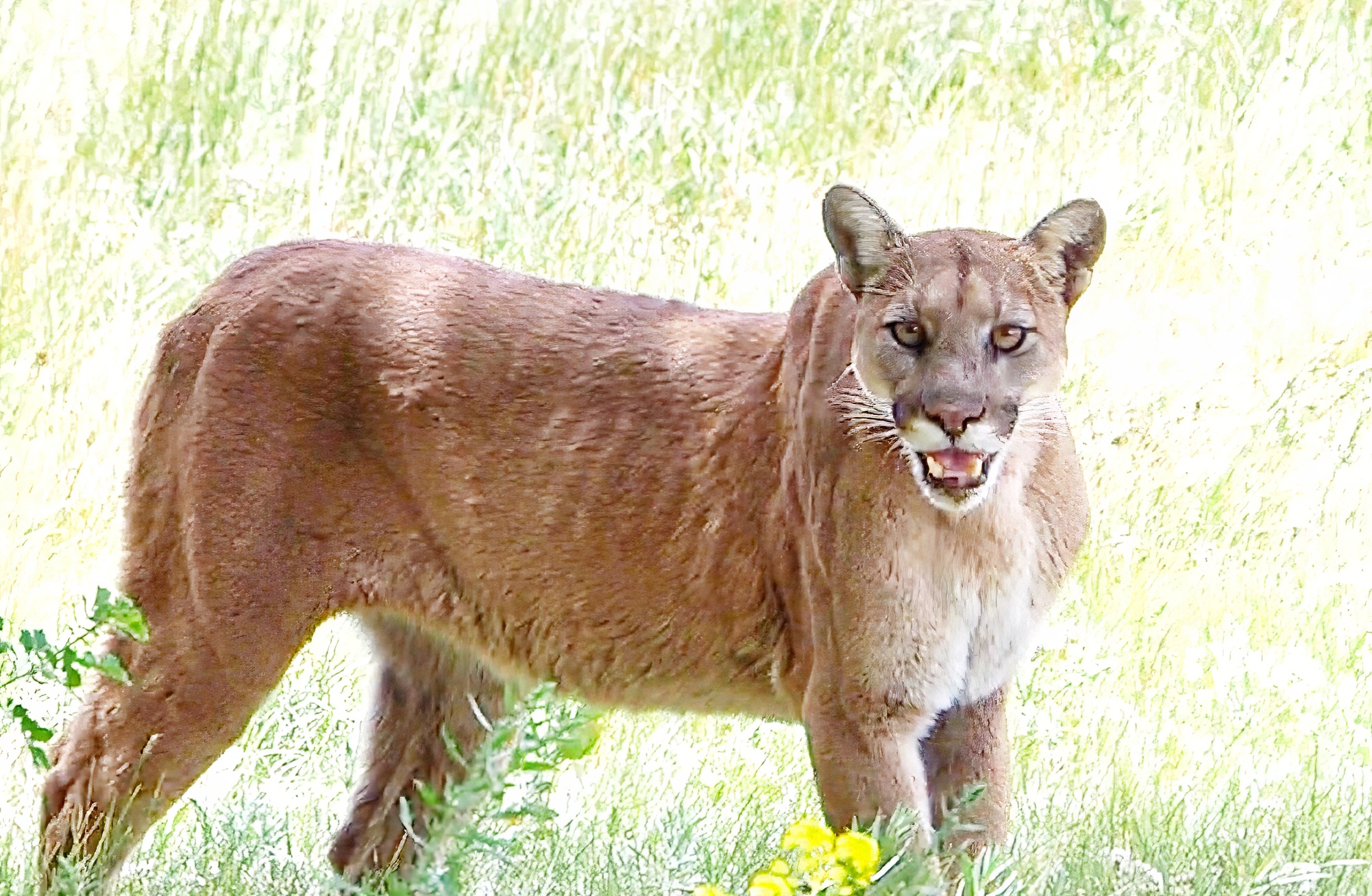
She sees us and she knows we see her. Her pink tongue pulses against the uprights of her ivory white canines. Her eyes fixate on us, her body frozen in the summer heat. Millenia of behavioral evolution swirls within her saying, “don’t move, they won’t see you.” But we do see her.
This time she is caught in the wide open—nothing is there to disguise her from our scrutiny. Standing in the open, mid-stride, sturdily balanced in the short grass of our side yard, is the huntress.
Moments before this, Jenny verbalizes what is obvious to both of us—“something is down there [in lower yard].” Poised on chairs beneath the shaded porch, our gazes strain into the mid afternoon sun. We are looking for something, anything. Creaking chair and deck board sounds tell me that Jenny is standing for a better view.
“It’s a fucking lion,“ she says in a hushed whisper that comes as a pressurized hiss. I stand up, my heart beating faster. More boards shift and the click of the front door door latch telling me Jenny is going for her camera.
Black-billed magpies were the giveaway. Eight or ten of the long-tailed birds are still going nuts. In an otherwise silent scene. The magpies keep shouting in overlapping strings of, “yak yak, yak, yak, yak, yak, yak, yak!” calls. Alarm chirps of robins are heard and now the “cleeeeeuh!” of a northern flicker who is perched atop a nearby power pole. Slowly, a kinetic jigsaw puzzle takes shape through the trees. I spot a line of a forearm, the diagonal sweep of a tail, a black-tipped ear, feather-like whiskers. Jenny comes just in time to see the whole picture emerge from the shadows as the big cat moves beyond the cottonwoods.
I say ‘her’, because we know this cat. She has been here before. Her name is “Nubs,” or more accurately, “Baby Nubs,” as dubbed by the Yellowstone cougar research team. Nubs does not have an identifying collar, rather, she has unique tail that is missing about one or two inches from the end. This is not an injury, instead, it is a genetic predisposition inherited from her mother—the original “Nubs.”
Jenny is now filming and I periodically hear the dull click of the shutter in silent mode as she takes still shots; each of our bellies are pressed firmly inward as we lean against the deck railing. Watching through my ten power binoculars, I can see every detail. Nubs is SO close. She is less than half the distance I usually throw the tennis ball for Hobbes when we play fetch. The hunter’s ribs are clearly discernible, squeezed taught by crisscrossing intercostal muscles, and her tail hairs glisten. I find myself sympathetically rocking back-and-forth with each of her body-swaying breaths—all the while, those teeth gleam against black lips, and those eyes—penetrating, unmoving. Physical proximity like this with any large creature gives the sense of merging with ‘the other’ in a way that defy explanation.
This is not simply a visual experience, it is a physical convergence. If it was cold outside, we might see a soft puff of her condensed breath, but today, I feel the heat is getting to her. Nubs’ breathing halts for an instant, her mouth opens a bit wider, as if to speak. The degree of intimacy I’m feeling right now saturates my body like a gush of hot blood. I’m frozen.
Aren’t these nocturnal hunters supposed to slink about only under the cover of darkness? Why would she brave the sweltering afternoon: what's her motive? The answer was already clear to us. Ninety-six days ago she was here, but she was not alone. She is doing this now because she’s a good mom; she’s providing for her four kittens. Nubs’ walks away in a smooth, liquid flow bone and muscle. Before she exits behind the screen of sagebrush northwest of the our house, she gives us one last sideways glance. The look seems to say, “you’ve seen me this time, but it won’t be so easy the next.”
The mountain lion family hung out at our house while we were away
Turning the clock back three months takes us into an airport. Jenny, young George and I were in Salt Lake. We have just re-entered the country from Central America (another outpost in the Puma concolor’s distribution) and our phones light up like Christmas trees. Texts, emails, and messaging apps buzz in a constant string of notifications.
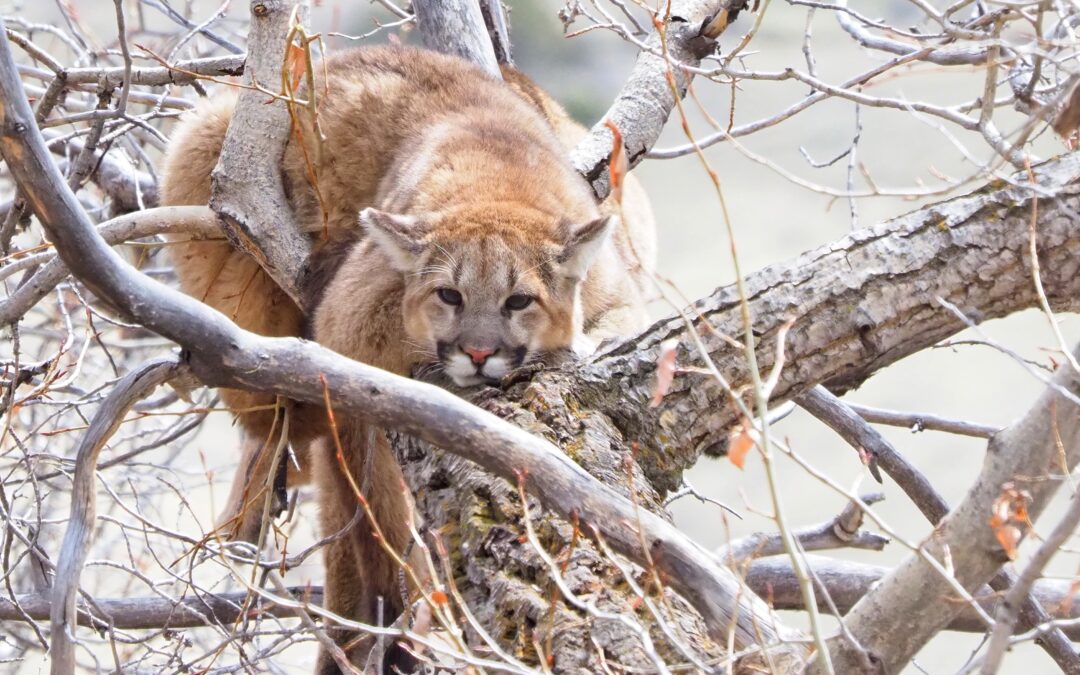
“There’s a mountain lion in your yard… with kittens!” reads one text. Another says, “cat is on your place with three… no, four kittens!” And the messages continue on: “cougars have a kill in your yard. They’ve been feeding on it for days.”
Go figure, right? The nature documentary drama—all of this big cat play—takes place while we’re away! Once our car rolls into driveway at home, after the stuffed suitcases are shlepped from the car to the house, and only after the dog is hugged around the shoulders and kissed on the nose, do he and I go back outside.
Uncovering the lion's kills and tracking her path through the sage
In the dark of night Hobbes and I walk into the lower yard to strap our camouflaged trail camera onto a tree near the creek. I have about as much idea where to put the camera as to where to set down a lander on the moon, but pick a good spot overlooking what we call the “lower crossing,” of the creek. When I check the data card the next morning there is nothing, only footage of a few grass stems trigging the motion detector. No cats.
The failure is not for lack of sound camera placement. As it turns out, my body radar must have been operating on high as the center of the frame of the camera is squarely on the cats’ feeding site! Small consolation however; the cougars appear to be gone. Figures.
Investigating further, I see tucked beneath the low limbs of the juniper tree at the lower crossing a butcher block, dinner table, litter box and bedroom, all rolled into one. Mule deer parts are strewn everywhere. Shreds of deer skin over here, stomach contents spilled over there. I start counting legs and immediately tally five—so there are at least two deer’s remains here. Leaves and evergreen needles are heaped into a small mound below the juniper about the circumference of a turkey dinner platter. Poking through the mound with a stick I find a lion scat; it’s the size of a bratwurst with rounded ends, a clear diagnostic of feline droppings.
I am dejected and feeling a bit envious towards all that our friends saw while we were gone. Making things worse, they gleefully share a steady stream of images of momma with the kittens walking, momma and kittens perched on a rock, kittens without momma, all of them posing for family photos looking right at the camera, and on and on. All of this, every last frame of it was either on, or along the edge, of our property. I want to stomp on their cameras and pretend none of this ever happened.
I resolve to make the best of things and flex my tracking muscles. My mission is to discover where she got these deer from and by what route. There must be some sign, right? On dirty hands and knees, I shuffle about with my nose inches from the earth, doing circles around the lower crossing. I search longingly for any bone fragments, tracks, signs of struggle, anything.
Mountain lions rarely eat mid-sized prey in the location they kill them. I have seen this unfold in real time where, following the take-down, a deer is suffocated to death by a throat-hold, then straddled by the cat, and drug by its still-warm neck, to a secluded spot to rest and eat. But I find zilch, no sign... nothing.
Days later, Hobbes and I return from a walk on a trail just north and west of the house. Plastered across that path and through the rolling sage is a line of hair so broad and distinct—about a foot wide—that it looks like someone offloaded a mini dump-truck’s-worth of deer hair as part of a twisted road paving operation. Deer passively shed hair at this time of year, but nothing like this. The breadcrumbs are too irresistible to ignore.
Though there isn't a crime-scene chalk line where the deceased fell, I can clearly see where a deer took its last breath. From there, Nubs started dragging. I read the direction of travel by the details in the hair. Rocks, sticks, even clumps of grass act like cutters on a cheese grater, skimming hair from the sliding stiff. Clumps of white stuff gathered on the side of first contact with little or no hair on the lee side. Individual hairs wrap around obstructions forming a U-shape with the ends pointing in the direction of travel. The hair peters out to almost nothing over the course of a tenth of a mile, but I can still seen enough to confirm that it leads straight to the feeding side at the lower crossing. This is one carcass accounted for, but what about the other one?
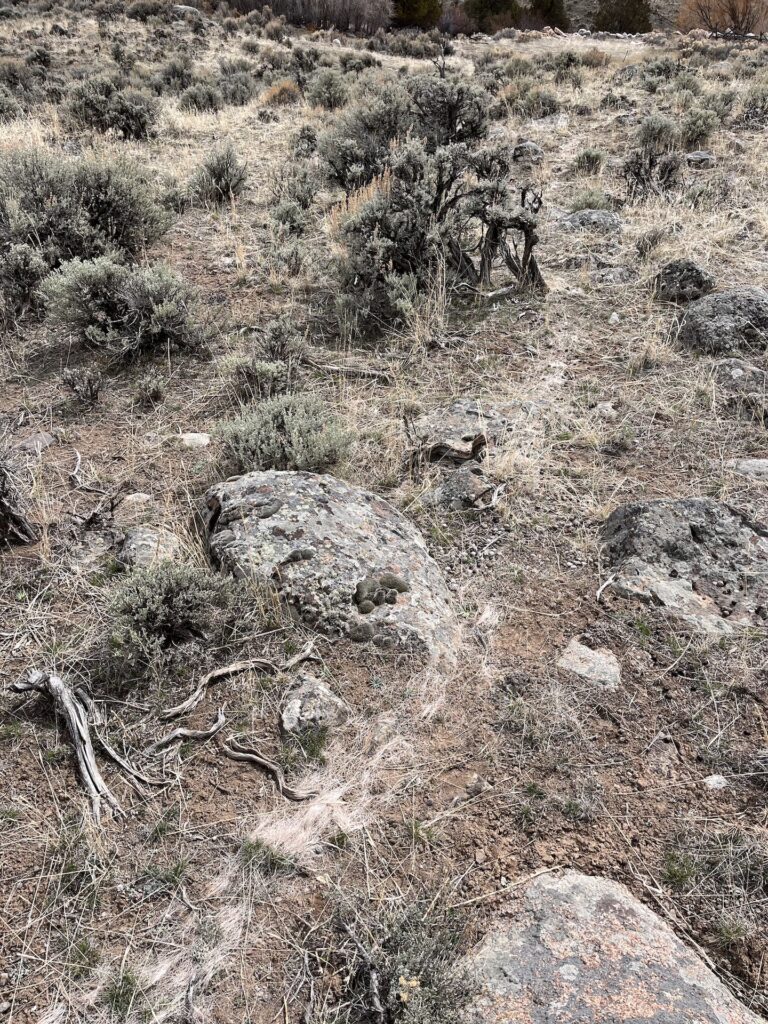
Jenny finds the second kill site the following day. This one too, is just north of the house and as it turns out, directly in the car turnaround spot of our driveway! Following this second path of hair, we find that it winds its way around the end of the house, joins the other drag strip, and dead ends at the same spot; the creek crossing just below the house.
Both carcasses were in plain sight of Jenny’s office desk.
All the more fascinating was that the neighbor’s sheep, with all their crying, newborn lambs, were never touched. How is that possible? With popcorn and candy sprinkled on the other side of the flimsy fence, Nubs and her kittens walked right past them nightly to hunt and eat wild prey. “Good mama,” I think to myself. This cat is truly wild, but managing to coexist with us, and doing so unbeknownst to almost everybody.
We would eventually get to see momma and all four of her kittens, capturing them on the trail camera, and Jenny makes some stellar images that I vow to revisit with paints and canvas.
Coexisting with Yellowstone's wild predators
Sherbet skies draw to a close on the day we locked eyes with Nubs. Jenny walks up the driveway, snapping photos of the fiery sunset, until she hears an urgent cry. Magpies are alarming to the north of the house again, and in the direction that Nubs went after leaving us earlier in the day. An elk soon alarm-barks too; this sound that is equal parts roar and shriek, booms from within the animal’s chest. Not given lightly, his wapiti bark sound is reserved for BIG things—like humans, wolves, bears and cats.
“I’m not going any further,” Jenny says to me as she briskly walks past me on the way back to the house. I tepidly stroll a bit further beyond her turnaround point—a place where the sagebrush grows taller and the driveway forks to the neighbor’s place. I hear the signals intensify, then move. I can’t see the elk, but in my minds eye, she’s on a hilltop looking down at that stealthy assassin slinking through the creek alders below. The magpies continue their commentary as the transit from right to left.
Everything about this says, “cat,” and it’s going toward the road. “I’m good,“ I say to myself, and mere seconds after my own about-face, my phone rings. A good friend’s voice comes through. “I know we haven’t chatted in a while, but I’m sitting on the road in my truck near your your mailbox and a mountain lion just walked out. It looked right at me and is now sitting on the hill between your mailbox and your house.“
The confirmation is sweet; like the the fading colors in the sky. I’m grateful for this day, knowing we are sharing a landscape with wild cats. And you might be wondering, no, we will not be sleeping on the porch tonight per our usual summer custom. Hobbes will also not be allowed to run free to drain his bladder at night either.
These encounters make it hard for me to think of living anywhere else. Our territories overlap with the wild ones here. We and Nubs are doing our best to get by, staying out of trouble, and raise our kids alongside one another.
Want to know when mountain lions are in your neighborhood?
Join us for the online masterclass Lions Among Us: Following the Shadowy Trail of North America's Big Cat. Learn more and register here.
If you're interested in more mountain lions in Yellowstone, check out the following posts:
Discovering what wildlife in Costa Rica and Yellowstone share: A common animal language