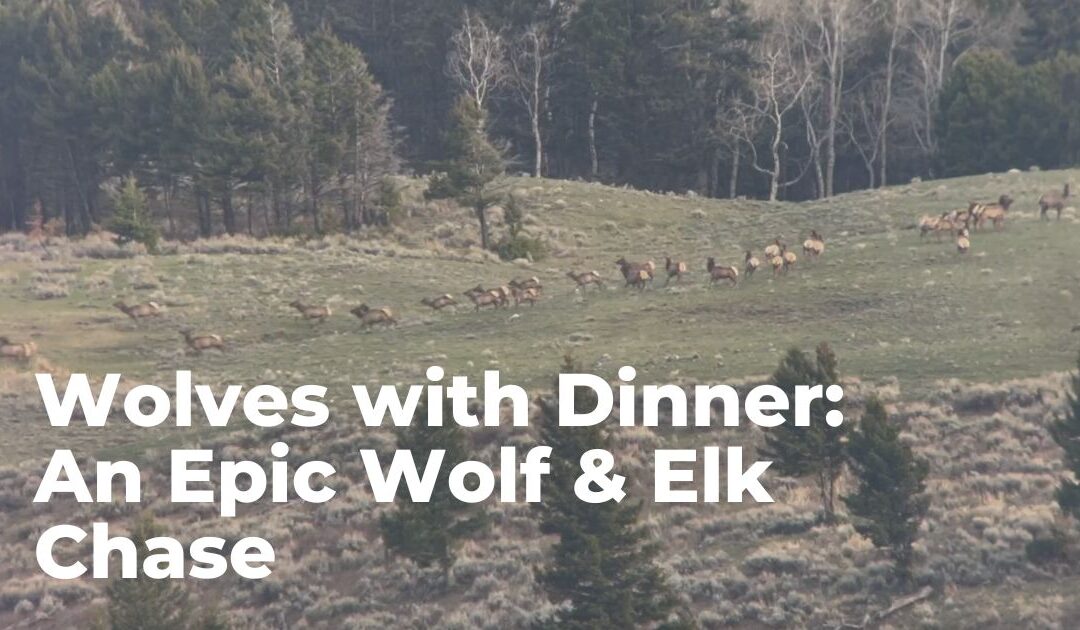
Jenny and I are enjoying the first pleasant evening of spring dining on the porch. We pull up our chairs and relax as warm, evening light spills over the mountain slopes and down into the valley floor. Faintly perceptible green squeezes its way up out of the soil across the hillsides. Jenny takes a moment to call her father for an update on his left knee; he’s just had surgery and we want to check in, but in an instant the whole scene is thrown into an uproar. She barely gets through the ‘hi, how are you's', when she raises a pair of binoculars and blurts out, “Holy $*&#@, Dad, I gotta go… I’ll call you back!” She sees a herd of more than one-hundred elk pouring over a distant ridge like a school of frightened fish—wolves in hot pursuit.
Spoiler alert/trigger warning: no kill is shared in this video
Jenny monitors the blow-by-blow action as I sprint to the back of the car, then to the truck trying to find the spotting scope, looking like a flailing Keystone Cop;. “Its in the garage,” Jenny yells out to me. I grab it and leave the garage door wide open and race to set up the scope on the porch.
Jenny is counting when I return to her side, “seventy-one, seventy-two…ninety-five, ninety-six, ninety-seven.” The number of elk keeps climbing. I scramble to move the large, glassy eye of our Swarovski scope into alignment. Her counting begins again. This time the sequence is lower, and annotated.
“One, two, three, four blacks. And one, no two, grays.”
I fumble with the knobs of the tripod, glancing back and forth at her, then putting my eye back to the eyepiece. I’m trying to pinpoint the animals. “Got ‘em,” I finally say aloud.
Elk are fanning out. White rumps turn and flare in all directions. I start counting too. We tally almost one-hundred and twenty elk and ten wolves—eight black wolves and two grays. This is the bulk of the
fifteen-member Rescue Creek Wolf Pack, we would later confirm with park research staff.
The elk pause. Fractured gangs take up posts on opposing ridges and exposed knolls; they are looking, listening. Despite the more than two miles between us, I can clearly see that their mouths are open, gasping for air, saliva frothing a the corners of their lips. The wolves are winded too. Some of the big dogs lie down, still others wander with a seemingly aimless mien.
An epic wolf and elk chase begins
Then all of a sudden, another chase starts. A single cow elk is separated from the topmost herd. Wolves rush from the sides and from behind. She runs for her life. Her fate is sealed, or so it seems.
A great many people think wolves can kill any animal they want, but this is not so. Intellectually, I know that only one in four or five chases ends in a kill in the best of times (such as during the harshest winters when prey find their energy reserves depleted and are prone to getting bogged down in deep snow), but as we watch, it seems like the odds are against this elk. Multiple wolves join the chase, then the elk initiates a classic predator aversion strategy—she runs downhill.
As the elk picks up speed, dust flies out behind her like detonating charges of gunpowder in a line of miniature explosions. The pursuit drops over 300 feet in elevation towards the Yellowstone River; all but one black wolf gives up the chase. At one point it looks like the dark canine makes contact, a ‘kiss’, to the elk’s flank and she reflexively kicks out to the side, but it never escalates. The chase continues.
Younger wolves don't often know when to quit. Pups and yearlings may have the physical strength to bring down an elk, but they haven’t learned the tactical skills to accomplish it. Nor do young wolves possess the cognitive wherewithal—unlike the 2+ year-olds of the pack—to know when to quit a fool’s errand before it goes too far. Once a wolf reaches two or more years of age, the amount prey they chase drops by about 50%, yet their success rate increases by about 90%. The eldest wolves typically make that decisive call on whether to pursue prey, or not, within the first hundred yards. Older wolves intuitively know that the average, healthy elk is stronger and faster than the average wolf, especially after an exceedingly mild winter like we've had this year.
Down, down the black wolf chases the elk until the ungulate drops from view behind the hills on our side of the river. The wolf stops just short of disappearing, turns, then heads back uphill. I use my video taken through the spotting scope of the interaction, in conjunction with Google Earth software, to retrace the entire route of the episode.
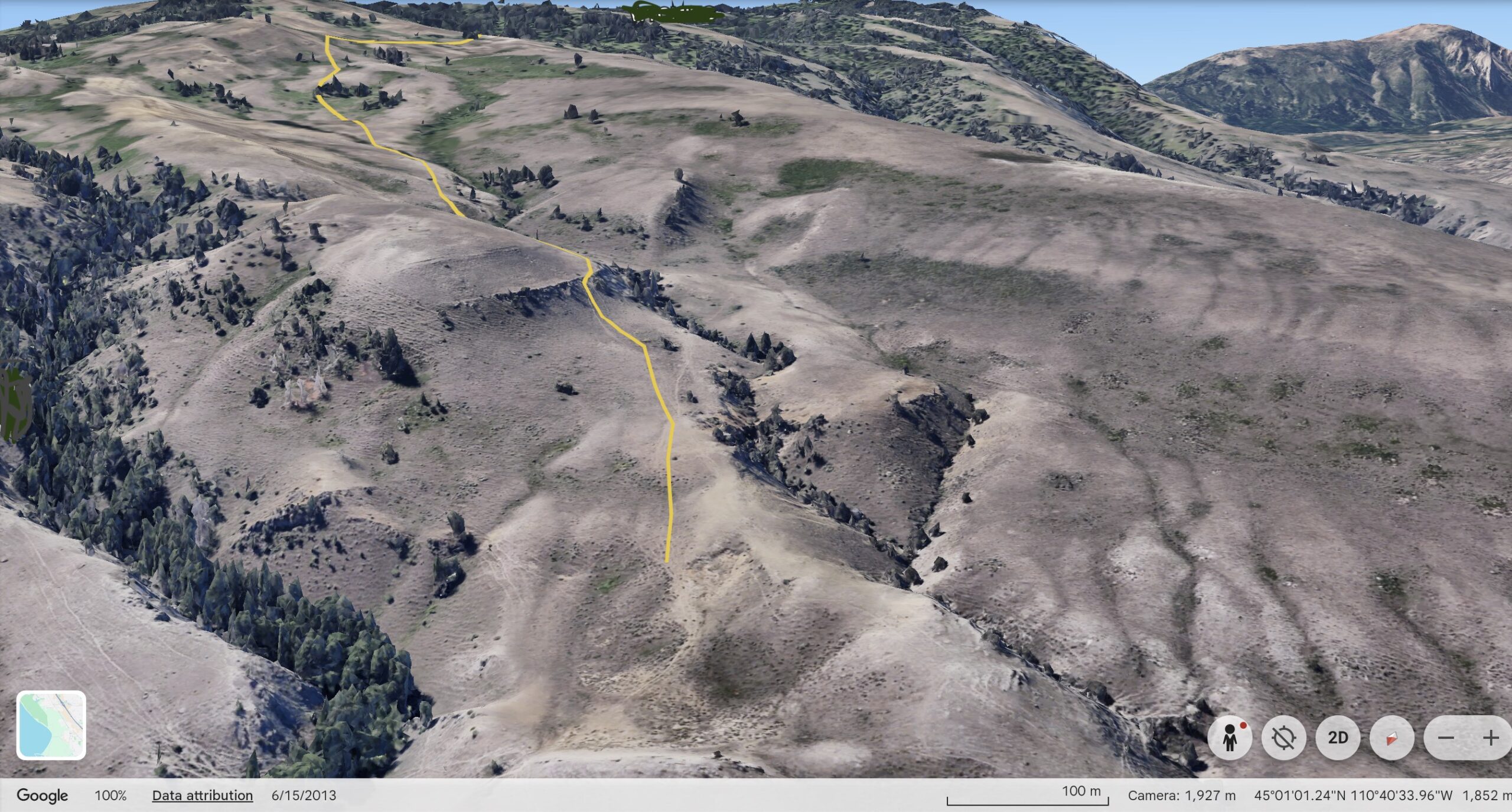
Retracing the elk and wolves' route
In total, the life-or-death footrace lasted three minutes and five seconds and covered 1.42 miles. The calculated speed for the encounter equals 27.63 mph. A single mile run at that speed would be covered in 2:10:43.
For perspective, the current world record for a human-run mile was set in 1999 by Morocco's Hicham El Guerrouj in a time of 3:43:13. This is still not even top speed for elk and wolves however; they have been known to max out between 30 to 35 mph, with the elk outpacing the wolves by just a couple clicks.
Given the uneven terrain, negotiating around and through trees, over sagebrush, and across rock outcrops, it's understandable that they weren't moving at absolute top speed, but it still astonishes me how fleet of feet both species are; and that they do so without injury or falling head over heels.
After nearly an hour, Jenny calls her father back, gives him our report, and checks on his knee. I text him a couple video clips film through the spotting scope; he responds to the text with the exclamation points emoji. As we sit down to eat our now-cold dinner, I can’t help but appreciate this meal in a different way.
More articles on wolves and wolf encounters:
Last of His Kind: Yellowstone's Wolf 21
25 Years of Yellowstone Wolves: Our Perspective
A Morning With Yellowstone Wolves
Ready to get up close and personal with Yellowstone? Join our email list to go beyond the surface and deepen your connection to the park.